Astronomers caught the first sign of a star 30 times more massive than the Sun exploding, then tracked its supernova for
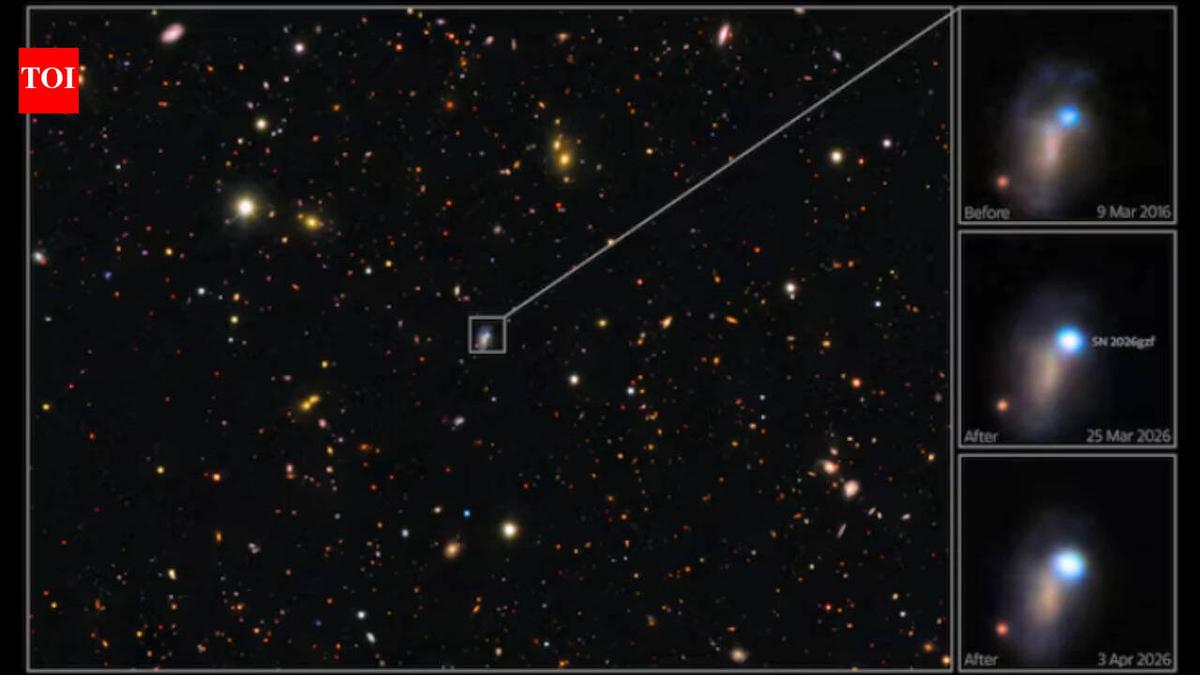
Astronomers recently captured a remarkable event: the explosion of a star estimated to be 30 times more massive than the Sun, known as supernova SN 2026gzf. Detected by China’s Einstein Probe on March 21, 2026, this supernova provided a rare opportunity for researchers to observe the entire process of a star's death, from the initial shock breakout to its fading glow, over nearly three months. The star, located approximately 500 million light-years away, was identified as a Wolf-Rayet star, which had shed its outer layers through powerful stellar winds before its explosive demise. The initial detection came in the form of a brief X-ray flare, a phenomenon known as "shock breakout," which occurs when a shock wave travels through the star’s surface as its core collapses. This event is notoriously difficult to observe, making this detection particularly significant. Following the flare, a global network of telescopes, including NASA's Chandra X-ray Observatory, was mobilized to monitor the supernova's evolution, allowing scientists to gather invaluable data across various wavelengths. Interestingly, this supernova did not produce a gamma-ray burst, a common feature in many powerful supernovae. This absence raises important questions about the mechanisms behind such explosions and suggests that massive stars can end their lives in diverse ways. The findings from this event not only enhance our understanding of stellar evolution but also provide insights into the fundamental laws of physics under extreme conditions, contributing to our knowledge of the universe's composition and the formation of elements essential for life.

Comments